Tag Archives: Code-Switching

Bilingualism Labs Around the World: Bangor

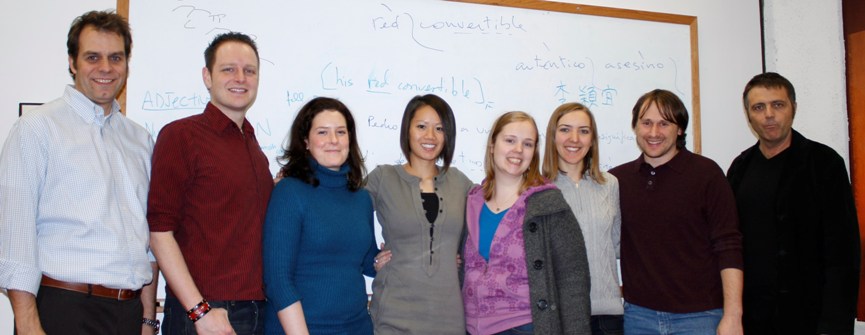
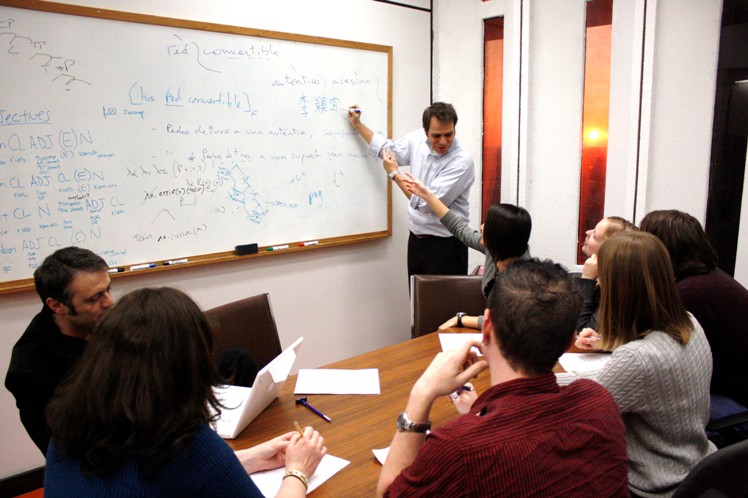
We’re starting a new series of posts about bilingualism labs around the world.  Our very first lab is the ESRC Centre at Bangor University.

The ESRC Centre for Research on Bilingualism in Theory and Practice (http://bilingualism.bangor.ac.uk/)  was established at Bangor on 1st January 2007 for an initial five-year period, with funding from the ESRC, HEFCW, and the Welsh Assembly Government.

It is the first research centre in the UK to focus specifically on bilingualism. As such it will be part of an international network of similar research centres with whom we would like to interact.

Research within the centre is centred around five research groups: Neuroscience Research Group , Experimental-Developmental Research Group, Corpus-Based Research Group, Survey and Ethnography Research Group, Speech Research Group. There is more information on the work of each of these groups in the following link:

http://bilingualism.bangor.ac.uk/research/index.php.en?menu=3&catid=6337&subid=0

The centre offers both an MA and a PhD in Bilingualism. For more information on our postgraduate programmes go to:

http://bilingualism.bangor.ac.uk/pgprogrammes/index.php.en?menu=11&catid=6554&subid=0

Whether you are a researcher or a practitioner interested in bilingualism, we hope that you will interact with us by visiting, writing, phoning, or attending one of our conferences and workshops. This weekend past (Oct. 2nd-3rd), the centre hosted the first Bangor Postgraduate Conference on Bilingualism and Bimodalism. It is aimed at Masters’ and doctoral level students to come together, present their work and come in contact with new ideas. The main goal of the conference is to establish a forum for postgraduate students interested in all linguistic aspects of Bilingualism and Bimodalism. The area of bilingualism being by definition interdisciplinary, the conference reunites contributions from numerous fields, ranging from linguistics to psychology, education and sociology. English-BSL interpreters will be provided for the duration of the conference to enable Deaf and hearing participants to fully engage in all conference activities. The invited speakers are: Marianne Gullberg (Radboud University Nijmegen and Max Planck Institute for Psycholinguistics, Nijmegen), Ineke Mennen (ESRC Centre for Research on Bilingualism in Theory and Practice, Bangor University), and Adam Schembri (Deafness Cognition and Language Research Centre (DCAL), Univeristy College London). To see the full conference program, please go to:

 http://bilingualism.bangor.ac.uk/conferencepg_programme.php.en

At the moment the centre has two calls for funding opportunities: the development fund  (http://bilingualism.bangor.ac.uk//devfund/index.php.en?catid=&subid=7211) and the visiting researcher programme http://bilingualism.bangor.ac.uk//research/VisitingResearchers.php.en?catid=&subid=7237).

If you are interested in bilingualism and in working with us, you can always apply for research associate status. Forms can be found on our website!
Spanglish o Ingañol?

Generally, when we see discussion of English-Spanish code-switching, the discussion itself is often times in English.  Evidence of this can be seen in the colloquial name for this phenomenon:  Spanglish. 

Since code-switching is the meeting of two languages, there should obviously be two discussions–one in each language.  Check out this article from El Mundo, one of Spain’s newspapers, which discusses it from the Spanish language point of view.  At one point they even use a different name for it:  ingañol.

http://www.elmundo.es/elmundo/2009/09/18/cultura/1253302554.html

International Conference on Minority Languages in Estonia

In May (28th-30th) there will be the 12th International Conference on Minority Languages (ICML XII) in Tartu, Estonia.  The ICML is hosted by the University of Tartu, but there are colloquia being held by affiliate departments.  One such department is the Department of Modern Philology at the Universitá degli Studi di Firenze, which will be holding a colloquium (themed session) entitled “Language contact and change in multiply and multimodally bilingual minority situations.”

The colloquium deals with bimodal bilingualism approached as a minority language in need of typological standardization and contact-induced grammatical change.

The colloquium’s homepage:

http://www.dipfilmod-suf.unifi.it/CMpro-v-p-236.html?newlang=eng

The ICML XII website:

http://www.icml.ut.ee/

UIC TiL: Shahrzad Mahootian

Shahrzad Mahootian of Northeastern Illinois University will be presenting this Friday at UIC Talks in Linguistics.  The talk will take place in 1750 University Hall (601 S. Morgan Street) from 2-3.

Abstract:

The Medium and the Message: Codeswitching in written discourse

“I am always the other but I get to choose my identity depending on context”

(Guillermo Gomez-Pena, 1993)

“Are you an independent *chica *or a cling-on?” (Latina 2001)
A variety of reasons and explanations have been put forth for why bilinguals codeswitch. Nearly all the data  considered has come from spoken, unscripted discourse, with very little attention paid to written texts.  Using data
from a variety of sources, I examine the motivations behind codeswitching in written texts. I employ Fairclough’s discourse model  (1995) in which he proposes a three dimensional approach for critical discourse analysis. The model is based on the interrelationship between *text, discourse practice * and* sociocultural practice*. He claims  that “social-identity struggles” are worked out through “new configurations of genres and discourse” (pg 8). An analysis of the “texture” (form, organization and content) of code mixing in written texts leads me to conclude that* *the use of mixed language is one *discourse practice* through which a ‘bicultural identity’ is defined and promoted (*sociocultural practice*). Specifically, the intentional use of mixed code in printed media serves as an identity marker for the bilingual speech community associated with this data (Mahootian 2005). The use of mixed code in the context of a national publication for example, such as *Latina*, is one way that the social-identity struggles of Latinos in the United States are expressed, and to a certain extent, resolved.

UIC Bilingualism Forum Update

The submission date for the UIC Bilingualism Forum has been changed to February 9th.

2009 UIC BILINGUALISM FORUM
The University of Illinois at Chicago, April 30 & May 1, 2009

http://uic.edu/depts/ling/BilingualismForum/BilingualismForm.html

The UIC Bilingualism Forum is dedicated to research in any area related to
bilingualism: Theoretical Linguistics, Codeswitching, SLA,
Psycholinguistics, Language Policies, Sociolinguistics, Neurolinguistics,
Cognitive Sciences, etc. Student presentations are especially encouraged.
Presentations will be 20 minutes each with 10 minutes for discussion.

CALL FOR PAPERS
Deadline for submission: 02/09/2009
Acceptance response in February 2009

Conference Announcements, Part 1

The UIC department of Spanish French Italian and Portuguese is hosting a Bilinguilism Forum in the spring. The call for abstracts went out earlier this month for the forum which is to be held on April 30th & May 1st at the Institute for the Humanities located in Stevenson Hall.

The Bilinguilism Forum will consist of three sections–Theoretical Bilingualism, Heritage Learner/Sociolingusitic Study, and Second Language Acquisition–with keynote speakers as yet to be officially announced.  The deadline for abstract submission is January 31st.

BAEC December 11 & 12

On the 11th and 12th of December the Chinese University of Hong Kong in Hong Kong will be hosting the Conference on Bilingual Acquisition in Early Childhood.  This conference on childhood bilingualism is organized by the newly established Childhood Bilingualism Research Centre at the Chinese University of Hong Kong & Co-sponsored by the Linguistic Society of Hong Kong.

http://www.cuhk.edu.hk/lin/conference/baec/

Of particular interest at the BAEC is a workshop on Sign Bilingualism in the Asia-Pacific Region.  The workshop itinerary can be viewed at http://www.cuhk.edu.hk/lin/conference/baec/signlang.html

Welcome to UIC’s Bilingualism Research Lab

The Bilingualism Research Lab, BRL, was founded this summer here at the University of Illinois at Chicago by Professors Luis Lopez Carretero and Kay Gonzalez Vilbazo.  Current student members of the lab are doctoral students Brad Hoot, Shane Ebert, and Laura Bartlett.  Current masters students who are part of the lab are Mirta Lee, Sarah Downey-Gimenez, and Jeanne Heil.

The BRL works in theoretical bilingual research, with a particular interest in code-switching phenomena.