FAQ: What is a heritage language?

FAQ3

A heritage language is a language learned the same way as a native language, but it is thought of as being learned in an incomplete manner. There are different degrees to which someone can be a heritage speaker. This can range from having only passive knowledge (understanding) to very advanced fluency (passive and active).

For example, a person can grow up in a house where his or her parents speak only Ukrainian, but outside the home everybody else speaks English. If the only Ukrainian input this person gets is from his or her parents then, this speaker will most likely become a heritage speaker of Ukrainian.

FAQ: Who is bilingual?

FAQ1

A bilingual speaks two languages. To what extent the speaker knows both languages may vary. One of the languages is going to be a native language. The proficiency level of the second language can range from knowing very little all the way up to having a second native language. Although technically all these speakers would be bilingual, very often the term “bilingual” is used for speakers that have a native or native-like level of language proficiency in both languages. The term multilingual is used to refer to people who speak two or more languages, being generally reserved for speakers of more than three languages.

Linguistic Link: Bilingual Children Have Better Memories

The British Psychology Society points us to yet another study about the positives of being bilingual. Read here  to find out more about research done at the Univeristy of Granada and the University of York in Canada, which presented on the benefits of raising children to be bilingual, specifically how it can boost one’s memory.

Linguistic Links: Bilingual Benefits for Seniors

According to the Journal of Neuroscience, bilinguals are able to perform tasks at a faster rate compared to monolinguals. The study showed that this was so because bilinguals are used to switching back and forth from one language to another. As a result, older adults at assisted living communities are encouraged to learn a second language to help decrease cognitive decline. You can read about it more at the Sunrise Senior Living Blog.

Linguistic Link: Chuh Kaw Go

It’s all in the vowels. So says linguist Corrine McCarthy from George Mason University. She recently spoke to WBEZ’s Curious City about the Chicago accent. But those vocalic peculiarities, as exhibited to comedic effect by an SNL sketch about Bears super fans, are only just the tip of the linguistic iceberg.

You can read (or listen to) the entire post to learn more about what other dialects are home to Chicago.

To answer the initial question, though, of where our unique accent comes from, UIC’s own Richard Cameron is quoted as saying that a likely possibility is that “the first dialect that gets [to a place] seems to win.” In our case then, it seems that that would be New Englanders in the mid-1800s.

Linguistic Links: The Ukraine, but not la Ucrania

Altering the names of places from their native language into a form that is more natural to speakers of another language is nothing new. However, Linguism, in a post reflecting on an article by the Independent, discusses different anglicizations of nations around the world. Of particular interest is when to use definite articles with particular countries, i.e. Ukraine vs. the Ukraine. Check out what they have to say on the issue or just take a glance at this map that details of the intricacies of the phenomenon in Spanish:

Publications: Babel No More

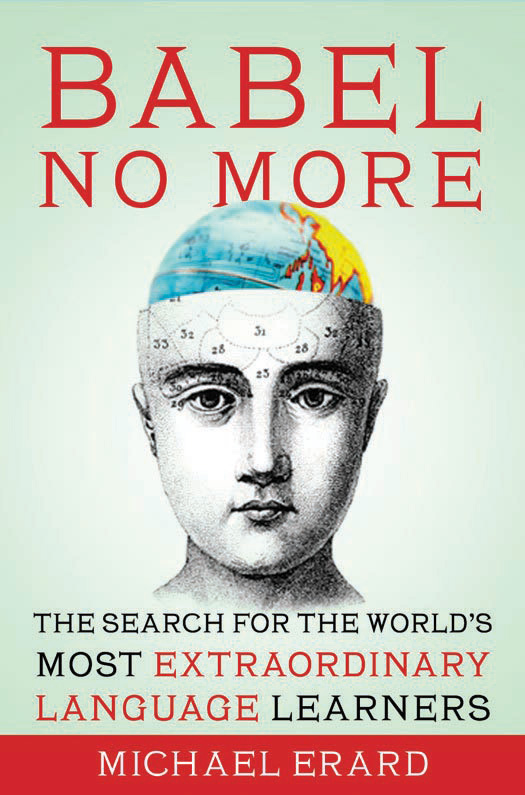
How do you become a master of multiple languages? That is the question central to Michael Erard’s new book, “Babel No More: The Search for the World’s Most Extraordinary Langauge Learners.” The New York Times describes it as “part travelogue, part science lesson, part intellectual investigation” and “an entertaining, informative survey of some of the most fascinating polyglots of our time.”

Here’s more information from the book’s website:

If you’ve ever tried to learn another language, you know how much time, energy, and brain power is required. Imagine a person who can pick up languages very easily. Someone who can navigate our world’s multilingual hullaballoo. Who can leap language barriers with a single bound. Who can learn without effort and remember indelibly. Such people aren’t parrots. They’re not computers. They’re language superlearners.

Michael Erard searched for these people, and when he found them — in history books and living among us — he tried to make sense of their linguistic feats and their mental powers. His book answers the age-old question, What are the upper limits of the human ability to learn, remember, and use languages?

UIC TiL: Fall 2012 Schedule

Mark your calendars and save these dates because the fall line-up for UIC Talks in Linguistics has been announced. All talks are scheduled on Fridays at 3 PM and will take place in University Hall 1750, located at 601 S. Morgan Street here in Chicago. We look forward to seeing you there for some interesting talks on a wide array of linguistic topics.

  • September 21: Masaya Yoshida, Northwestern (Psycholinguistics)
  • October 19: Kay González-Vilbazo, UIC (Code-switching)
  • November 2: Bernie Issa, UIC (SLA)
  • November 16: Craig Sailor, UCLA (Syntax)
  • November 30: Nicholas Henriksen, Michigan (Phonology)

Titles of the talks as well as abstracts will be announced closer to the dates listed for each.

Linguistic Link: Heavy ‘Medal’ Verb Debate

The competitive spirit of the Olympics is spreading even to linguistic levels. Apparently some are perturbed by the growing trend to use ‘medal’ as a verb now, as in Danell Leyva medalled in the men’s all-around, instead of saying that athletes ‘win medals’. A silly debate for sure as not only is this a very productive phenomenon in the English language (see also ‘friend’ instead of ‘add as friend’, ‘text’ instead of ‘send text message’, etc.), but even the Oxford English Dictionary has accepted it as a verb for years. Read more about it The National.