Category Archives: Linguistic Links

Linguistic Link: What Do Linguists Do?

Literacy News has a great litle blurb on a question all of us get on a regular basis: What do linguists do? Although it mentions a wide-variety of the avenues available in the linguistics field profession-wise, it does make clear a common misconception. That is, being a linguist does not mean that you are “fluent in five languages and spend your day thumbing through dictionaries.”

Linguistic Link: Clever Apes on Bilingualism

Chicago public radio station WBEZ 91.5’s Clever Apes focused on bilingualism recently. Be sure to check out their segment which highlights the benefits of being bilingual. It also includes an interview with Dr. Boaz Keysar from the University of Chicago who studies language and decision making.

Linguistic Link: The Life of a Hyperpolyglot

Timothy Doner, a 16 year old sophomore from New York has become part of the small community of persons who are multilingual (hyperpolyglots). He currently knows over a dozen languages and has astonishingly learned them in less than five years. His quest at becoming multilingual began at 13 after learning some Hebrew for his bar mitzvah. He does not think of language entirely as a form of communication but more of as a science. Timothy Doner, among other hyperpolyglots defy the critical period hypothesis.

Check out the full video and article.

http://www.nytimes.com/2012/03/11/nyregion/a-teenage-master-of-languages-finds-online-fellowship.html?_r=1

Linguistic Link: Spanish… A Sexist Language?

Are Spanish speakers guilty of women’s rights discrimination…?

Recently, some feminist-minded Spanish regional authorities have challenged the “sexist” grammar of Spanish. Ignacio Bosques, a member of the Real Academia Española has written an article which criticizes and dismisses the language guidelines offered by the regional authorities and several institutions. The Real Academia Española (Spanish Royal Academy, RAE) has been a protector of the purity of Spanish since 1713. Some of the accusations of Spanish being sexist are the following:

“Spanish words are either of the masculine or feminine gender. A male citizen, for instance, is a “ciudadano” while a female citizen is a “ciudadana.” A group comprising only female citizens would be called “ciudadanas.”

But if the group includes even a single male, the plural becomes the masculine “ciudadanos.”

“Parents” translates as “padres” (fathers), a human being is “hombre” (man), and so on.”

Have gender and the Spanish language conspired against women’s rights?

Here is the article on the issue, read on and find out what type of changes are being pitched by feminist-minded institutions.

http://bikyamasr.com/61605/spaniards-in-passionate-debate-about-sexist-grammar/

If you are intrigued, check out the full article written by Ignacio Bosques.

http://cultura.elpais.com/cultura/2012/03/02/actualidad/1330717685_771121.html


Linguistic Link: Music and Bilingualism

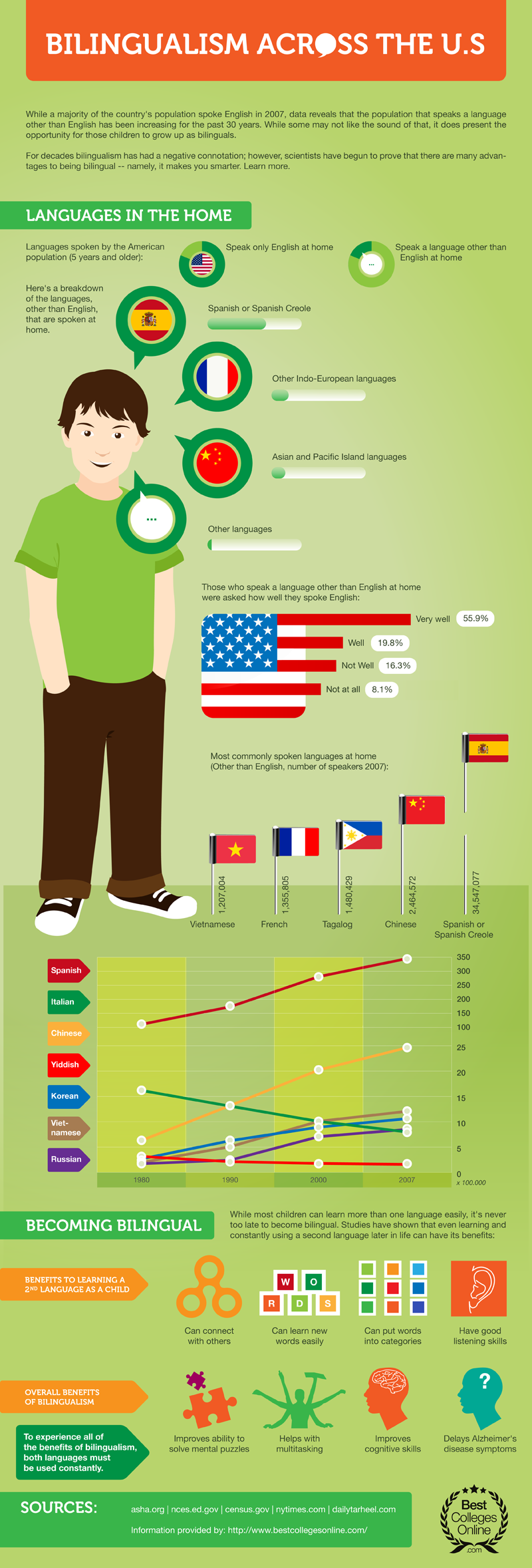
Approximately one in five children in the U.S. speak another language other than English at home. However, many times second and third generations do not develop their second language (which they later regret). This is the case of the constituents of Girl in a Coma, a Mexican American Band of San Antonio. Nina Diaz, the lead singer of the band admits that she regrets not learning Spanish as a child. The band now incorporates Spanish in their music as a form of learning the language. “Nina Diaz says she grew up very much like the slain Tejano singer Selena.” For those who don’t know, the late Selena was a Hispanic singer who, unfortunately like many Mexican Americans, did not know Spanish; however, she learned Spanish through her music and popularized the Latin genre. Nina Diaz now follows Selena’s foot steps of learning Spanish by singing it.

Check out the NPR report about Girl in a Coma.

http://www.npr.org/2011/10/19/141475757/girl-in-a-coma-rockers-tackle-their-second-languag

Take a listen to a rock cover of Selena’s “Si Una Vez” by Girl in a Coma, and the original by Selena. Would you agree that their method of learning Spanish has worked?

So there you have it…if music is your thing, use it as a tool to resurrect your native language or simply to learn a foreign language!


Linguistic Link: Bilingualism in the United States

Have Americans fallen behind in the world of languages? According to the United States Census Bureau, only 20% of Americans speak another language other than English. However, these statistics are most likely erroneous. Read the following article by Michael Erard from the New York Times and learn how he explores the issue.

http://www.nytimes.com/2012/01/15/opinion/sunday/are-we-really-monolingual.html?_r=3

How bilingual are YOU?


Linguistic Link: Benefits of Bilingualism

Does knowing a second language and exposing it to your children have non-linguistic benefits…?

In this short video, Sam Wang, a neuroscientist at Princeton University points out the benefits of exposing infants to a second language. These include: the ability to cope with conflict cues better, increasing theory of mind, and delaying dementia among others.

Take a break and watch this short video that will encourage you to learn a second language.

Now you know how to increase brainpower by utilizing the power of language!

Linguistic Link: Tonight’s Code-switching is brought to you by…Telemundo!

The New York Times reports that Telemundo is trying a new approach in their effort to stay competitive with Univisión: running shows in Spanglish and English subtitles.

…The programs will feature a sprinkling of English and be available with English subtitles — something not as readily found on the competing Univision…

“If you think about Telemundo as a narrower broadcast network, you quickly get to the place where, like all broadcast networks, your mandate must be to go for the widest possible audience,” said Lauren Zalaznick, the chairwoman of entertainment and digital networks and integrated media for Telemundo’s parent company, NBCUniversal.

Bilingual Hispanics, defined as speaking English more than Spanish or Spanish and English equally, are 82 percent of the United States Hispanic population, according to a report released this year by Scarborough Research, a consumer research firm.

This group has more disposable income than the more Spanish-speaking recent immigrants, with 12 percent of acculturated Hispanic families earning $75,000 to $100,000 a year, the study said.

Advertisers also may be attracted by the fact that Hispanics watch more TV as a family, with Spanish-speaking grandparents often gathered around the TV with their predominantly English-speaking grandchildren, according to the Association of Hispanic Advertising Agencies. Shows that incorporate both languages and cultures can hook multiple generations.

“You may have a home full of generations with different perspectives,” said Roberto Orci, chief executive of Acento, a Los Angeles-based advertising agency aimed at Hispanics.

Very interesting, ¿no les parece?

Linguistic Link: “I speak Spanglish … I say ‘Necesito ayuda con my homework.'”

NPR shines a spot on one of the first bilingual schools in the U.S., Coral Way Elementary School in Miami-Dade County.  In 1963 the school opened its doors to the children of political refugees from Cuba.  The goal was not only to teach them English, but to maintain their Spanish as well.  The school has been a model of bilingual immersion programs ever since.

NPR’s reports that

Teachers at Coral Way cringe when they hear Spanglish. They demand proper English and proper Spanish. This kind of rigor and rich immersion in the two languages is very different than what most Latino school students experience.

Although we here at the Bilingualism Research Laboratory can appreciate the need to maintain a high level of Spanish input and output to ensure fluency, it’s important to understand that statements such as these only serve to further stigmatize code-switching.  Remember — code-switching, especially intra-sentential code-switching, requires a high level of proficiency in both languages! (Poplack 1980)