Category Archives: Uncategorized

How do kids absorb language?

Happy New Year! Here is the first interesting article for 2017.

The University of Victoria, under Alexandra D’Arcy, will be conducting a five-year research to better understand how young kids absorb language. The project will pay especial focus to who the individuals influencing the child’s language development are. ‘I want to know when exactly it is and then how it is that kids start moving changes forward,’ says d’Arcy.

To accomplish this goal, young children (3-4 years old) will be monitored for 5 years. Both children and their parents will be wearing a microphone for 8 hours a day for two weeks, four times a year. This will allow the researcher to see how their language changes over that course of time and how it shifts in relation to their peers and caretakers.


To read the original article visit: http://www.cbc.ca/news/canada/british-columbia/uvic-child-language-study-1.3877712


Why Bilinguals Are Smarter

18GRAY-articleLarge-v2

Scientist have recently found more benefits of being bilingual than just the advantage of being able to communicate with a wider range of people. In a recent study by the psychologists Ellen Bialystok and Michelle Martin-Rhee (2004) bilingual and monolingual preschoolers were asked to sort blue circles and red squares presented on a computer screen into two digital bins — one marked with a blue square and the other marked with a red circle. The findings showed that the bilinguals were quicker at performing this task. Another similar study in 2009 by Agnes Kovacs of the International School for Advanced Studies in Trieste, Italy, 7-month-old babies exposed to two languages from birth were compared with peers raised with one language. The results were similar to the 2004 study. The babies exposed to a bilingual environment quickly learned to switch their anticipatory gaze in the new direction while the other babies did not.

Original Article: http://www.nytimes.com/2012/03/18/opinion/sunday/the-benefits-of-bilingualism.html?_r=0

Too smart to learn a new language.

MITnews_LearningLanguage_0

Amy Finn, a postdoc at MIT’s McGovern Institute for Brain Research, together with a group of neurologist and psychologist found evidence that having developed cognitive skills can, indeed, be an obstacle for adults when trying to learn a new language. According to the study, “when learning certain elements of language, adults’ more highly developed cognitive skills actually can get in the way.” Children are better skilled at picking up  subtle nuances of a new language, which gives them the ability to speak a new language like a native speaker within months of living in a foreign country. While adults only focus on learning the vocabulary needed to navigate a shopping market or order food in a restaurant.

Original Article: https://news.mit.edu/2014/trying-harder-makes-it-more-difficult-to-learn-some-aspects-of-language-0721


Bilingualism and Cognition

Bilingualism

Assistant Professor Yang Hwajin from Singapore Management University (SMU) School of Social Sciences conducted studies on bilingualism and cognition. In one study Professor Yang found that low socioeconomic status children who spoke two languages performed better in behavioural tests than monolingual. Similar results where found in another study which involved infants of low socioeconomic status. Bilingual infants from low socioeconomic status displayed a greater cognitive development than monolingual infants of the same status.This can demonstrate that bilingualism could help the development of children in deprived environments.

Original Articles: http://www.asianscientist.com/2015/03/features/bilingualism-and-the-brain-smu-yang-hwajin/

Hong Kong twin study

chinese-twins-Merideth-xs-two

An international study is in progress which involves twins, it aims to see if the ability to learn languages applies equally to Chinese and English.This is based on a phenomenon about bilingual learning in Hong Kong that suggests that mastering Cantonese and learning to write characters was harder for some Hong Kong children than learning English. Researchers want to look at the individual genes and find out which components of reading and writing are associated more with which genes. They hope that the study will uncover the best way to teach children languages, which will allow them to figure out whether they should teach Chinese and English in the same way or teach the two languages differently.

Original Article: http://www.scmp.com/news/hong-kong/article/1738569/hong-kong-twins-may-unlock-riddles-chinese-language

Advantages as a Bilingual

bilingualediu

According to Associate Professor Callahan, from the University of Texas, there are several advantages as a bilingual, however only 1 in 4 Americans can talk in another language. This can be due to many social and political factors that believe that speaking only one languages is better, which can be contradicted by research. According to past research findings, bilinguals are more likely to get a job when they interview, develop a greater sense of empathy, possess better problem solving skills and sharper mental perceptions, among other things. The promotion of bilingualism in more homes could help children contribute more as adults.

Original Article: http://qz.com/358708/know-more-than-one-language-how-your-bilingual-brain-could-pay-dividends/

Learning a new language can strengthen your brain

brain

Professor Ping Li, along with Penn State colleagues, believe that learning and practicing a second language can change your brain network, structurally and functionally. They studied 39 native English speakers’ brains for a six-week period, half of the participants were asked to learn Chinese vocabulary. Of the subjects learning the new vocabulary, those who were more successful in attaining the information showed a more connected brain network than both the less successful participants and those who did not learn the new vocabulary. MRI scans demonstrated that the brain network of the successful learners was better integrated. The findings are consistent with changes that occur in the brain as a result of learning a second language, no matter the age of the learner.

Original Article: http://www.centredaily.com/2015/02/14/4603896/focus-on-research-learning-new.html

Human language reveals a universal positivity bias

The University of Vermont’s Computational Story Lab conducted a study focusing on whether an emotional connotation of the most commonly used words could reveal a preference for positivity and joy over sadness and cynicism. They decided to use 100,000 of the most frequently used words in the media, amongst the top ten most popular languages. Native speakers were asked to rank these words on a nine point emotional scale, with 1 being the most negative or saddest, 5 being neutral and 9 being the most positive or happiest. They were able to conclude that the most popular languages tend to prefer happier words than those with negative connotations. Researchers found that Spanish was the happiest, and English was amongst the top five. They believe this will pave the way for the development of powerful language-based tools for measuring emotion.

Original Article:http://www.upi.com/Science_News/2015/02/10/Spanish-is-the-worlds-happiest-language/3881423593145/

Evolution of language may be due to population size

A group of linguists and evolutionary biologists from the Australia National University conducted a study which demonstrated that languages evolve at different speeds, depending on the size of the population that speaks them. They compared 20 different Polynesian languages, which shared a common ancestor, considered to be “sister languages”. The researchers decided to compare the languages with different population sizes and observe if there were any differences in the vocabulary. The results demonstrated that languages with larger populations gained new vocabulary faster than the languages with a smaller population size. More often the languages with a smaller population tended to lose vocabulary faster than those in a larger population, which is similar to the biological evolution. The researchers believe that they still need to continue looking at other languages in order to confirm these results, and assume that the general feature of language evolution.

Original Article: http://www.popsci.com/languages-may-evolve-based-size-population-speaks-them

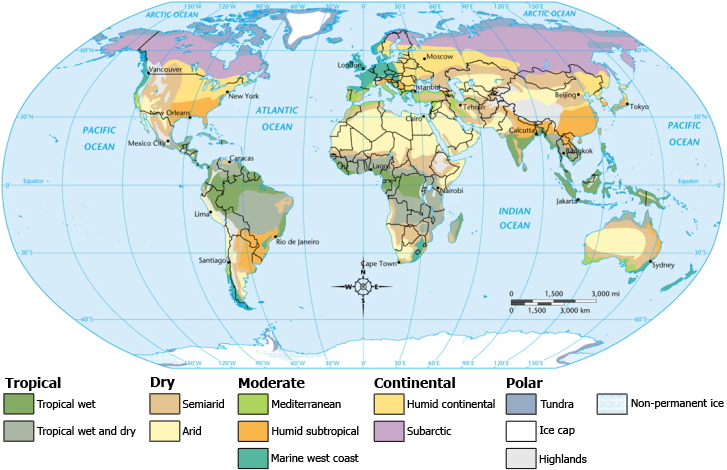
Climate affects languages

ClimateMap_World

Sean G. Roberts, scientist at the Max Planck Institute for Psycholinguistics, Evolutionary Anthropology and Mathematics in the Sciences in Nijmegen, along with other researchers have looked at a total of 3,750 languages from different linguistic families. They were able to find a correlation between humidity and tone pitch. The humidity allows the mucous membranes in the larynx to remain moist, making them more elastic. Due to this there is a wider range of tone pitches in regions with a higher humidity, meanwhile, languages with a more simpler tone are commonly found in drier regions. This can serve to explain why tonal languages, found in the Tropics, Subtropical Asia and Central Africa, are rarer in dry areas, such as Central Europe. The findings demonstrate that climate is able to determine the development of languages.

Original Article: http://www.science20.com/news_articles/climate_ change_may_shape_languages_too-152559